

A story that found me
Archetypes have a way of finding us while letting us think we are the ones discovering them. This is one of those experiences. I didn’t go looking for this story. I had been working with the word sovereignty for months, building a talk and drafting a manuscript around it, when, late in the process, I came across a medieval English tale in which sovereignty is, quite literally, the answer to the riddle. It was one of those moments of awe, like the one I had while researching the Wild Woman.
The tale is The Wedding of Sir Gawain and Dame Ragnell, a Middle English romance from the fifteenth century. In depth psychology we don’t read a fairy tale as a history of something that happened once. We read it as a picture of something that keeps happening, inside us and between us. Every figure in the story is a part of the psyche. Every turn in the plot is a turn the soul takes.
I’ll retell the story in parts, and after each part, we’ll look at it through a depth lens. Take what speaks to you.
Part I: The King in the forest
King Arthur is hunting in Inglewood Forest. He has followed a great deer deep into the woods and left his company behind. He is alone, and dressed for the hunt, not for battle.
Out of the trees steps a knight in full armor, Sir Gromer Somer Joure. He has an old grievance: Arthur once took his lands and gave them to Gawain.
Arthur points out that killing an unarmed man would bring Gromer only shame. So the knight offers a bargain instead. Return to this spot in one year, alone, and bring the answer to a single question. Answer truly, and you live. The question is this: What do women most desire?
In myth and fairy tale, the King usually stands for the ruling attitude of a life: the values, habits, and certainties that govern how we live. Here that ruling attitude has wandered off alone, chasing its desire, past the edge of what it knows.
The forest is where the realm’s rules don’t reach. It is the place in us we haven’t mapped, the wilds of the psyche. And it is there, unguarded and unarmored, that the King meets what his own rule dispossessed: Gromer’s grievance. Something was taken from him and handed to someone else, without a reckoning. Now it returns, armed.
Many of us know this moment. A life that has been working well, competently governed, runs into something it pushed aside long ago. A loss, a symptom, a longing, a conflict that won’t resolve, a memory. It arrives as a question we can’t answer.
Notice what kind of question it is. The King can’t fight his way out of it. He can’t command it. He has to go and find out something he doesn’t know, specifically about women and the archetypal feminine. That is often how the deeper work of a life begins. Something catapults us out of the comfort of our known reality.
Part II: The year of wrong answers
Arthur rides home shaken and tells his nephew, Sir Gawain. Gawain has a practical plan. The two of them will ride out in different directions, ask everyone they meet, and write every answer down.
They fill books. Women desire riches, some say. Beauty. Fine clothes. To be flattered. To be wooed. A handsome, lusty husband. No two answers agree. The books grow thick, and Arthur knows in his bones that none of it is the answer. The year is running out.
This is the ego doing what it does best: gathering information, making lists, consulting the collective. It is competent work, and it fails.
Every one of the answers is something given to a woman, or something she is for. Riches bestowed. Beauty admired. Flattery received. A husband provided. Each defines her from the outside, by what she can be offered or how she can be seen.
These are the culture’s answers, and many of us carry them as our own. They live in us as voices that say what we should want, what would finally be enough. We can collect them for a lifetime and still feel the question pressing.
More information won’t save the King. The answer is not in the books. It is somewhere he hasn’t yet been.
Part III: The Loathly Lady
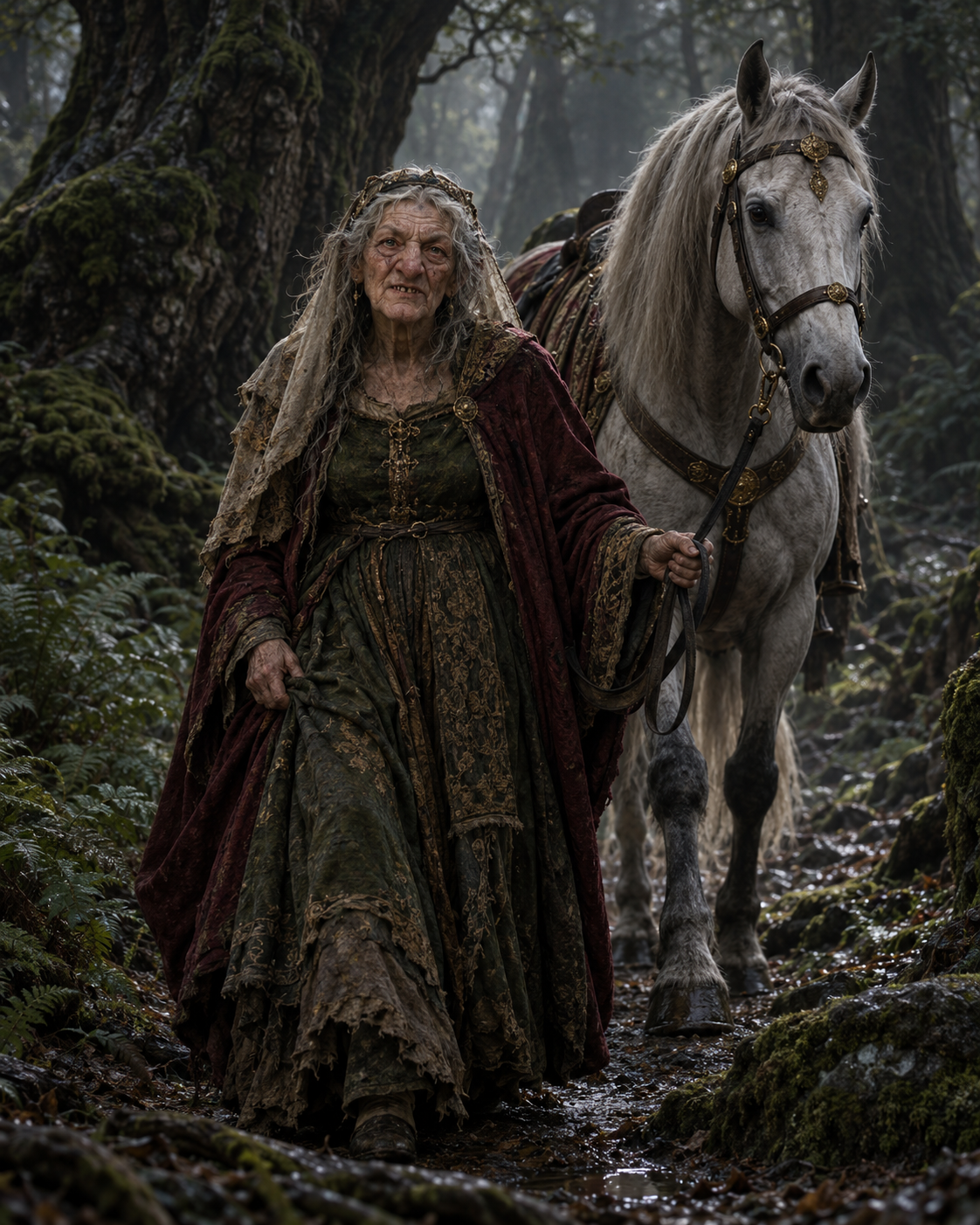
Near the end of the year, Arthur rides into Inglewood again and meets a lady on a richly harnessed horse. The poem spares nothing in describing her. She is monstrously ugly: tusked like a boar, bleared, misshapen, a figure the court would laugh out of the hall.
Her name is Dame Ragnell. She tells the King: I know the answer. Your books are worthless. I will give you the true answer, and save your life, on one condition. Sir Gawain must marry me.
Arthur goes home in despair. When he tells Gawain, Gawain doesn’t hesitate. He would marry her, he says, if she were a fiend, to save his king. He agrees freely.
On the appointed day Arthur faces Gromer. He gives Ragnell’s answer: What women desire above all things is sovereignty, to have their own will. Gromer knows at once it is true. He curses whoever told the king, and he lets Arthur go.
The answer the King most needs is held by the one figure his court would most reject. This is the shadow, and it is not only the place of what we are ashamed of. In Jungian work we say there is gold in the shadow. What we exiled because it was too much, too ugly, too unwelcome, often carries exactly what would save us.
Ragnell is the exiled feminine. She is everything that was declared unmarriageable: appetite, anger, age, wildness, the face that doesn’t please. She rides in boldly, not cowering but richly adorned, on a fine horse, naming her price. Her loathliness has not taught her to be smaller.
This figure is older than Arthur’s court. In early Irish myth, a hideous hag guards a well, and only the young man who will kiss her drinks from it. When he does, she becomes radiant and names herself: she is Sovereignty, the spirit of the land itself. In the oldest layer of this image, the Loathly Lady doesn’t merely know about sovereignty. She is it.
Gawain’s first move comes out of devotion to his uncle, King Arthur. He knows nothing about Ragnell herself. He says yes to her before he knows what will come of it, without bargaining, without being told she will become beautiful. But it is not the act that will make him worthy of her.
Part IV: The wedding in full daylight
The court would like this marriage done quietly. Queen Guinevere suggests an early, private ceremony, with as few eyes as possible. Ragnell refuses. She will be married openly, at high mass, before everyone.
At the wedding feast she sits at the high table in her rich clothes and eats with enormous appetite, tearing at the meat with her hands, clearing platter after platter. The court is appalled. Gawain stays courteous beside her the whole time. He does not apologize for her, and he does not hide her.
Here is a hard teaching about shadow work. It is not enough to borrow the shadow’s gifts in secret and keep her out of sight. Ragnell has saved the king, and she will not be married in a back room. What we reclaim has to be brought into the light of our actual lives, where people can see it.
And her appetite! For many women the deepest exile was the exile of hunger: for food, for pleasure, for space, for a life of our own. Ragnell eats as if no one ever taught her to be smaller. This is instinct come home, the Wild Woman at the wedding table.
Most of us know the court’s discomfort from the inside. It is the part of us that winces when we take up room, that wants our wildness kept private and tidy. The tale doesn’t shame that part. It simply lets the feast go on.
Gawain’s steadiness is the quieter miracle. He doesn’t perform enthusiasm, and he doesn’t flinch. He stays. Before he does anything heroic, he is simply present to her as she is.
Part V: The wedding night
In the bridal chamber, Ragnell asks her new husband for a kiss, for courtesy’s sake if nothing else. Gawain says he will give her more than a kiss. He turns toward her, and finds lying beside him the most beautiful woman he has ever seen.
She explains. She was enchanted, and the spell is only half broken. Now he must choose. She can be beautiful by night, in their bed, for him alone, and loathly by day before the court. Or she can be beautiful by day, admired by the world, and loathly when they are alone.
Gawain is caught. He turns the choice over, and either answer costs her something. Then he does the thing, the one thing that changes everything. He tells her: Choose for yourself. I put the choice in your hands. Do as you will.
She thanks him. Now you have given me sovereignty, she says, and I will be beautiful both by day and by night. Then she tells him the terms of the spell. Her stepmother had cursed her to stay loathly until the best knight in England married her and gave her sovereignty. Both conditions had to be met. Marriage alone was not enough.
The curse is a split. Lovely for the world and loathly at home, or lovely in private and loathly in public. Many women will recognize this. We learn to be one thing in the boardroom and another in the kitchen, admired in one room and unbearable to ourselves in another. The enchantment is not ugliness. It is division.
Now look at the shape of Gawain’s dilemma. Either choice he makes, he still makes it. Whichever he picks, he governs her. The trap holds only as long as he believes the choice is his. The way out of the dilemma is not a better answer. It is giving the question back to the one it belongs to.
This is the moment Gawain becomes worthy of her. Not when he agrees to the marriage, not at the wedding, not by being the king’s nephew or the court’s most famous knight. The spell named “the best knight in England,” and Gawain becomes that knight in the act of releasing his claim. His worth was not handed to him in advance. It was revealed at the exact point where something was asked of him, and he chose to hold his power rather than use it.
Notice that the riddle is answered twice in this tale. Arthur speaks the answer and saves his life. But he only knows it as information. Gawain enacts it, in a bedroom, with no one watching, and it breaks the enchantment. Knowing what sovereignty is changes very little. Giving it is what transforms.
One gesture, two liberations. Ragnell is made whole, beautiful by day and by night. Gawain is freed too: from the burden of deciding someone else’s life, and from the kind of power that has to possess in order to feel secure.
This happens between people, in any love where one person says to another, the choice is yours. It also happens within one psyche. There is a ruling voice in each of us that wants to decide how the exiled parts of ourselves should appear: presentable here, hidden there. Sometimes the most sovereign thing that voice can do is step back and let the returning soul choose its own face.
What the tale asks of us
The tale ends with every thread drawn back into relationship. Even Sir Gromer, the armed grievance from the forest, is reconciled with the king. What was dispossessed comes home.
The answer to the riddle is not freedom. Ragnell doesn’t ask to be released from the marriage. She asks for the authority to choose within it. That is what I mean by sovereignty: not the absence of ties, but the right to govern one’s own life inside them.
A few questions to sit with this week:
- Where in your life have you been split, presentable in one room and hidden in another?
- What part of you did your inner court call too much?
- Where are you waiting for someone to say the choice is yours? And where might you say it to yourself?
- Whose choice have you been holding that was never yours to make?
Come and work with this story in person. On Saturday, November 14, I’m leading a full-day workshop with the Jung Society of Utah in Salt Lake City: Sovereignty: The Queen, the King, and the Sacred Marriage. We’ll go beyond reading the tale and into the experience of it, through guided imaginal work, reflective writing, active imagination, dream inquiry, and dialogue in pairs. The workshop runs 11:30 AM to 4:30 PM MT at Full Circle Yoga & Therapy, with 5 CEUs for Utah mental health professionals.
The evening before, Friday, November 13, I’ll give the talk Sovereignty: Meeting the Inner Queen and King at the Utah Museum of Contemporary Art, 6:30 to 9:00 PM MT. Advance tickets are less than same-day.
Reserve your place at the workshop · Friday talk tickets
If you can’t be in Salt Lake City, this is the work I do with clients every week. I see individuals online across North America, and I offer a complimentary consultation to see whether we’re a good fit. Book a complimentary consultation
Next time, we turn from the Queen to the King: Percival, the wounded Fisher King, and the question that heals the wasteland.
In service to soul,
Stacey